
IMMAA 2026 in Macau Drives Global Collaboration on the Future of Media
- IMMAA Communication
- October 30, 2026
- Conferences
- 0 Comments
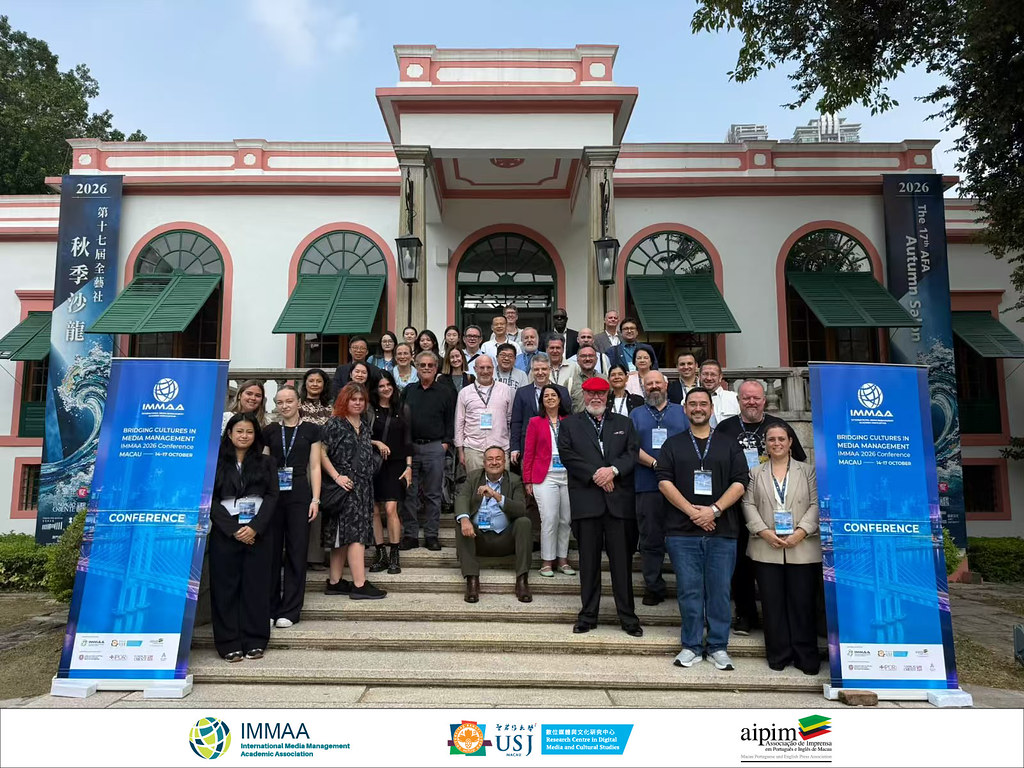
Hosted by USJ, AIPIM, and IMMAA, the four-day event in Macau bridged Eastern and Western perspectives to shape the future of media economics and management as a unique discipline and field of practice— laying the groundwork for forthcoming research publications, the transition to AIMME, and the 2027 WMEMC conference in Mexico.
The International Media Management Academic Association (IMMAA) conference “Bridging Cultures in Media Management” brought together more than 50 academics from 11 countries in Macau, connecting researchers, journalists, students and industry professionals to discuss economic, business and digital transformations of the media. Held from 14 to 17 October 2026, with academic sessions from 14 to 16 October, the conference’s main outcomes included the production and sharing of knowledge, strengthening multinational collaboration among researchers, and preparations for new publishing and association initiatives to advance theory and practice.
IMMAA collaborated with the University of Saint Joseph (USJ) and the Macau Portuguese and English Press Association (AIPIM), to produce the conference. Warm thanks to José Manuel Simões, Paulo Faustino, José Miguel Encarnação and Gregory Ferrell Lowe, and of course the Executive Board of IMMAA.
The opening day took place at Casa Garden, a heritage site owned by the Fundação Oriente. The other two days convened at the Portuguese Institute of the Orient (IPOR). The 2026 IMMAA conference was the first major international event for USJ’s newly established research center for Digital Media and Culture Studies (FRAME).
The interplay of Eastern and Western influences, together with Macau’s connections to diverse cultural context spanning the Global North and South, provided a particularly suitable context for comparing developments in media companies and industries. For IMMAA President Dr. Gregory Ferrell Lowe, the conference provided an invaluable opportunity to bridging cultural perspectives and academic traditions, demonstrating the importance of international dialogue for the development of media economics and management as a unique multidisciplinary field.
“Macau provided a particularly meaningful setting for the IMMAA conference, bringing together different cultural perspectives and academic traditions. The diversity of participants and topics demonstrated the value of international dialogue in advancing research and strengthening our field of media economics and management.”
Dr. Gregory Ferrell Lowe | IMMAA President
For José Manuel Simões, of the University of Saint Joseph and a conference co-organizer, this multicultural setting helped connect research traditions and bring the university closer to the professional sector.
“Macau demonstrated its ability to bring cultures and research traditions together, connecting academics and professionals from different countries in a dialogue that enriches both knowledge and its practical application.”
José Manuel Simões | University of Saint Joseph | Co-organizer
The opening session, “Similarities and Differences in East and West Media Practices”, coordinated by Paulo Faustino and José Miguel Encarnação, brought together Anna Jupowicz-Ginalska, Elena Gutiérrez Rentería, Francisco Rolfsen Belda, João Francisco Pinto and Gregory Ferrell Lowe. The discussion connected management and governance practices with funding models, professional traditions, and political and institutional frameworks. The comparison highlighted the importance of considering each market’s specific characteristics, even as technologies and business models circulate internationally.
This perspective took concrete form in the panel “Media Business Models, Sustainability, Audiences and Challenges – from a small city to a region”, moderated by Jerusa Antunes. Representatives of O Clarim, TDM, Hoje Macau, Macau Business and Plataforma shared their experiences of business models, sustainability, audiences and changes in the sector. Their contributions helped explain journalistic practices in Macau and their connections with China, particularly the Greater Bay Area, linking the size of the local market, linguistic diversity and the regional circulation of information.
“Interaction between academia and the media industry is essential to a better understanding of journalistic and business models, both in theory and in practice. Research provides concepts and evidence to examine the challenges facing the sector, while the experience of newsrooms and media organizations helps test those ideas against everyday realities and identify new questions for research.”
José Miguel Encarnação | AIPIM | Co-organizer
“The greatest value of this conference lay in comparing different media systems and professional experiences, enabling us to produce and share knowledge about the management, governance and sustainability challenges facing the sector.”
Paulo Faustino | IMMAA and University of Porto | Co-organizer
Artificial intelligence and trust were two central themes of the proceedings. On 15 October, Prof. Eli Noam delivered the opening keynote, “Media Management and Policy for AI-Human Interaction”, in a session moderated by Gregory Ferrell Lowe. The keynote connected management decisions, public policy and interaction between AI systems and human beings, highlighting the need to preserve human responsibility throughout technological transformation.
In this context, incorporating AI into media organizations requires preparing teams, defining responsibilities and establishing criteria for content oversight and evaluation. Efficiency gains must be considered alongside editorial quality, professional autonomy and accountability. This discussion linked technological choices to broader questions of governance and the role of public policy.
On 16 October, Prof. Terry Flew delivered the plenary lecture “AI and Media Trust”, introduced by Mercedes Medina, who chaired the session. The lecture placed trust at the heart of the discussion of AI and the impact of global platforms. Transparency in the use of these technologies, information verification and clear editorial responsibilities were particularly relevant in a context where content production, recommendation and circulation depend on systems that audiences do not always understand. The two plenaries thus offered complementary perspectives on the central role of human beings and the institutional and economic conditions underpinning media credibility.
The diversity of the 16 parallel sessions broadened this discussion. Papers on multicultural journalism, content localization, public service, AI in newsrooms, rights and regulation connected changes in professional practices with organizations’ responsibilities towards their audiences. Sessions on streaming, fan communities, events, cultural consumption, Chinese creative industries, and business models showed how value creation depends on business strategies, technological infrastructure, and relationships with audiences across different markets.
Other contributions examined sustainability and entrepreneurship in traditional media, digital journalism practices, resistance, visibility, trust and management education. Creativity and cultural work in the AI era, media management skills and human responses to generative AI completed this overview. The Chinese-language session on intercultural consumption, brands and communication strengthened linguistic diversity and the presence of local perspectives. Overall, the programme encouraged international comparison while recognising differences between media contexts.
Paulo Faustino’s academic participation included moderating the session “Public Service Media and State Communication in Transition” and presenting “Towards a Theory of Public Service Media Governance: Introducing the QuadrifaceMedia Framework” in the session chaired by Amelie Lu. He also co-authored, with Daniel Filipe Farinha, a paper on the sustainability and infrastructure costs of crypto-art platforms and, with Miguel Rosa Duque, a presentation on an AI framework for Macau’s filmmakers. These joint contributions extended the conference’s academic scope to the connections between technological innovation, sustainability and the creative industries.
“The Macau conference opened a new chapter in international cooperation, which we aim to sustain through joint research, a book featuring conference papers, and a stronger association in media economics and management.”
Paulo Faustino | IMMAA and University of Porto | Co-organizer
The institutional dimension of the conference was particularly evident at the General Assembly, coordinated by Gregory Ferrell Lowe and Paulo Faustino. Faustino’s and Lowe’s contributions revisited IMMAA’s history and outlined the challenges of integrating the World Media Economics and Management Conference into the future AIMME. The discussion connected this accumulated experience to the need to bring academic communities, resources, and networks together into a stronger international structure with broader representation.
For IMMAA President Dr. Gregory Ferrell Lowe, this transition is an opportunity to strengthen the association’s international structure and support the continued development of the field.
“This transition is an important step towards ensuring the long-term sustainability of our association and its annual conference. By bringing our academic community together under a formal international structure, we aim to support the continued growth, reach and impact of media economics and management research worldwide.”
Dr. Gregory Ferrell Lowe | IMMAA President
Connections between participants extended beyond the sessions. The welcome reception on 14 October at the Macau Military Club took place in a building of Portuguese colonial architecture, providing an opportunity for colleagues from every continent to share cultural references and academic experiences informally. At the closing dinner on 16 October at LVSITANVS restaurant, Portuguese food accompanied reflections on the conference and discussions of opportunities for research cooperation and institutional collaboration.
José Manuel Simões also highlighted the involvement of colleagues from the Department of Media, Art and Technology, FRAME-affiliated researchers, student ambassadors and institutional partners. Welcoming participants, supporting the sessions, and creating opportunities for exchanging ideas were part of a collective effort that connected organization, education, and research. For the centre he leads, the conference provided an opportunity to affirm its commitment to international collaboration and sustained dialogue with industry.
“We want the bridges built in Macau to lead to continuing research projects, academic exchanges and collaboration between universities and businesses, making FRAME a lasting meeting point for this international network.”
José Manuel Simões | University of Saint Joseph | Co-organizer
The conference also reached audiences beyond the academic community. In comments broadcast by Rádio Macau on 14 October, Paulo Faustino warned of the concentration of advertising revenue in major technology companies, linking the survival of media outlets to state sovereignty. TDM’s television report “Imprensa em análise em Macau” (“Examining the Press in Macau”), broadcast on the same date, covered the conference’s opening and its focus on the specific characteristics of the local press. These reports helped bring questions of sustainability, autonomy and news diversity into public debate. TDM coverage: radio and television.
In the print press, reports published on 14 October 2026 in Jornal Tribuna de Macau and Macau Daily Times highlighted the program, the dialogue between researchers and professionals, the lectures on AI and trust, and the proposed integration of the associations. Macau’s selection as host had already been reported on 21 October 2025 by Ponto Final and Macau Business / Macau News Agency, with republication in Plataforma the following day. These articles document the announcement stage, when preliminary dates were provided and subsequently updated in the final program.
The conference’s main academic outcome was the production and sharing of knowledge on media economics, management, and governance through the exchange of research findings, professional experiences, and perspectives from different media systems. The breadth of the sessions helped deepen understanding of AI, trust and sustainability, connecting theoretical contributions with the concrete problems facing organizations.
Stronger multinational cooperation was another significant outcome. Contacts between researchers and institutions opened up opportunities for comparative research, joint projects and academic exchanges. The participation of journalists, businesses and students broadened this network and created opportunities for knowledge exchange that could extend into teaching and research, depending on how the opportunities identified are followed up.
Planned developments include a book featuring papers presented at the conference that should be developed into peer reviewed quality chapters for the anthology. Preparing the full manuscripts and subjecting them to scholarly review will consolidate the contributions and extend the circulation of results to readers who did not attend. The publishing project will continue to share knowledge and help turn the discussions held at the conference into a resource for reference and research.
The transition to AIMME will take a major step forward during the 2027 World Media Economics and Management Conference (WMEMC), scheduled from May 18-21 at Universidad Panamericana in Guadalajara, Mexico. The event will convene a significant General Assembly to conduct elections for the association’s inaugural leadership team. This will mark the beginning of a new and exciting chapter in the field’s ongoing development – an historic experience for our international academic community of media economics and management experts. As the inaugural conference for AIMME, WMEMC 2027 will provide a platform for continued research exchange, international collaboration and the development of the field.
“Macau marks the end of one chapter and the beginning of another for our international academic community. We look forward to continuing this work in Guadalajara in 2027, bringing researchers and professionals together to strengthen collaboration and advance media economics and management worldwide.”
Dr. Gregory Ferrell Lowe | IMMAA President
Related Posts