
The Economics of Global Digital Media
- IMMAA Communication
- March 16, 2026
- Reviews
- 0 Comments

Challenges and Risks of AI-Orchestrated Media Management
Author:
Zvezdan Vukanovic
About the book:
Eli Noam, Video 2040: The New MediaTech, AI, and the Next Generation of Media. Izdavač: Edward Elgar Publishing Limited, 2026.
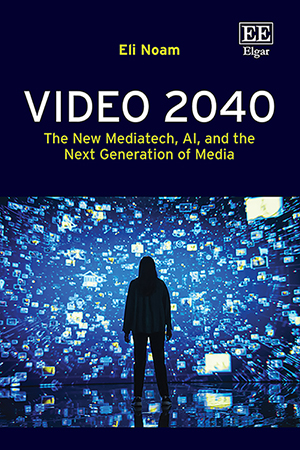
Eli Noam’s book, Video 2040: The New MediaTech, AI, and the Next Generation of Media, appears at a historically transitional and almost paradoxical moment. Noam is professor emeritus at Columbia University in New York and a member of the World Economic Forum and the Council on Foreign Relations. Streaming has consolidated into a planetary infrastructure of cultural circulation and everyday consumption, normalizing “on-demand” access as the dominant mode of audiovisual life, while at the same time, within the industry’s speculative horizon, thinking has already moved beyond it: toward immersive AI environments and interactive, adaptive narrative forms in which personalization governs the logic of production, distribution, and reception. Noam’s key intervention is that he treats this future-oriented “scan” not as a terrain of promotional excitement, but as an object of disciplined inquiry. The book poses a deceptively simple question: what, concretely, comes after streaming within the technical, economic, and institutional frictions through which every transition must pass?
Methodologically, Noam is explicit about the asymmetry between what, in media-cultural and techno-economic terms, can be forecast and reinterpreted with a certain degree of confidence, and what remains structurally and innovatively indeterminate and variable—such as the ways audiences understand technologies before they are fully configured, as well as the delayed and uneven arrival of new regulatory regimes. By synthesizing long-term trends in semiconductor capabilities, declining unit costs of data processing, and the historical fall in the cost per gigabit of use, Noam constructs an empirical platform from which the horizon of 2040 becomes more than a “speculative media spectacle staged for effect” (roughly a century after the advent of commercial television). His concept of growing “bit-richness” functions as a conceptual bridge between technology and culture: cheaper and faster bits expand the feasible design space of mediated experience, whose adoption still depends on complementary technologies and services, standards, content supply, governance, and the plain consumer inertia of habit.
More specifically, the first part of the book offers a historical genealogy of video, moving from film and broadcast television through multichannel systems and streaming, before going on to frame “Video 4.0” technologically in terms of immersion, participation, interactivity, individualization, and embedded transactionality. The second part then inventories the technological substrate on which such a regime would have to rest: processors and GPUs; cloud-based production and distribution; wired and wireless networks; haptics and interface design; blockchain infrastructures; and real-time rendering. The third part focuses on the infrastructures and content logics of games, immersion, interactivity, metaverses, and personalization and then, crucially, confronts their pattern of weak or uneven adoption. The fourth and fifth parts ask what an AI-orchestrated ecosystem would mean for content formats, business models, industrial structure, cybersecurity, and regulation.
Several chapters are especially successful in translating technical parameters into institutional roles: processors, layers of cloud infrastructure, latency, reliability, and throughput, as well as spectrum scarcity. He treats the latter not as a technical footnote, but as a lasting constraint of media economics, one whose ultimate consequence is that video production and distribution become increasingly centered on data centers, which in turn shape ever more powerfully both the upstream and downstream flows of audiovisual culture—from financing decisions, through script development and virtual-production workflows, to postproduction rendering and the logistics of content delivery networks (CDNs)—especially in a media ecology increasingly destabilized by deepfakes, piracy, and uncertainty about the provenance of information.
Perhaps the book’s most effective analytical dimension is its persistent explanation of why “next-generation video” has repeatedly failed to achieve the audience uptake it promised. Noam rejects monocausal explanations—whether the romantic claim that failure reflects a lack of creativity, the cynical claim that corporations suppress change, or the patronizing claim that users are simply stubborn. Instead, he argues that the accumulated challenges and obstacles to the broader and more intensive adoption of next-generation video include high costs, immature standards, weak interoperability, latency constraints, bandwidth scarcity, insufficient content supply, fragmented demand, and—most decisively—the absence of a compelling value proposition strong enough to trigger user adoption. In that way, he offers a counterargument both to techno-utopian triumphalism and to techno-skepticism. Within this causal framework of real rather than mystical disappointment—disappointment with intelligible causes that can, in principle, be altered as technologies mature and evolve—Noam positions artificial intelligence as the variable most likely to change the equation of consumer adoption of next-generation video.
In the fourth and fifth parts, AI becomes an orchestration layer capable of making a complex modular system legible, usable, and economically scalable across industrial applications—audience analytics, support for script and story development, editing, translation and dubbing, marketing optimization, and the definition of AI agency. His model of “three-sided video” is defined by the interposition, at the application layer, of a personal AI agent between viewer and platform. Instead of an audience that is merely profiled, targeted, and behaviorally “nudged,” the viewer is represented by an intelligent module designed to execute the user’s preferences and instructions: filtering advertising, organizing recommendations from trusted sources, assessing the credibility of information, blocking malicious actors, finding favorable terms, and carrying out transactions. Consequently, platform power shifts into an AI-to-AI framework, while control over the agent—its design, ownership, default settings, and auditability—emerges as a new strategic bottleneck in the media economy. Noam anticipates that, viewed from this perspective, the future is not the total displacement of streaming, but a modular spectrum of user choices over how much agency, effort, and immersion people actually want.
The deeper structural question is whether the sector will evolve toward decentralized, interoperable arrangements or consolidate into oligopolistic “walled garden” ecosystems. Noam’s expectations—grounded in network effects and economies of scale—tilt toward concentration even as he considers the countervailing pressures of Web3 and the open-source imaginary. One of the book’s most valuable contributions is the way it connects industrial structure with governance and cultural market power, within which gatekeeping becomes a mechanism for shaping visibility, monetization, and, ultimately, cultural legitimacy.
In the regulatory chapter, Noam returns to familiar pressure points—privacy, consumer protection, cybersecurity, media pluralism—while also foregrounding issues that become especially acute in immersive, AI-mediated environments: algorithmic bias, liability for interactive harms, and intellectual property under conditions of intensified disinformation enabled by deepfake technology, thereby extending the operational scope of interface functionality. His proposal for Open Video 4.0 Access seeks to translate the traditions of communications regulation into an idiom of access rights and governance over the market power of key interface platforms, making such governance a credible regulatory principle. He also argues that this kaleidoscopic mosaic is gradually becoming an arena in which the judgments of AI agents generate something akin to jurisprudence—a “common law” for AI and interactive media—rather than a single all-encompassing solution.
Video 2040 is at once a map and a warning. It maps the technical, economic, and institutional components required to move convincingly beyond streaming, and it warns that the next generation of video will be shaped as much by governance choices—interoperability, access, accountability, and control—as by technological paradigms. In sum, Eli Noam’s latest book provides researchers in media and communication with a vocabulary for creative thinking; for industry actors, it functions as a disciplined inventory of the constraints that promotional narratives routinely suppress; and for media policymakers and regulators, it offers a timely reminder that the “future of video” is not a niche entertainment matter, but a contest over the legitimate agency of artificial intelligence and the attention economy within the very texture of social life.